
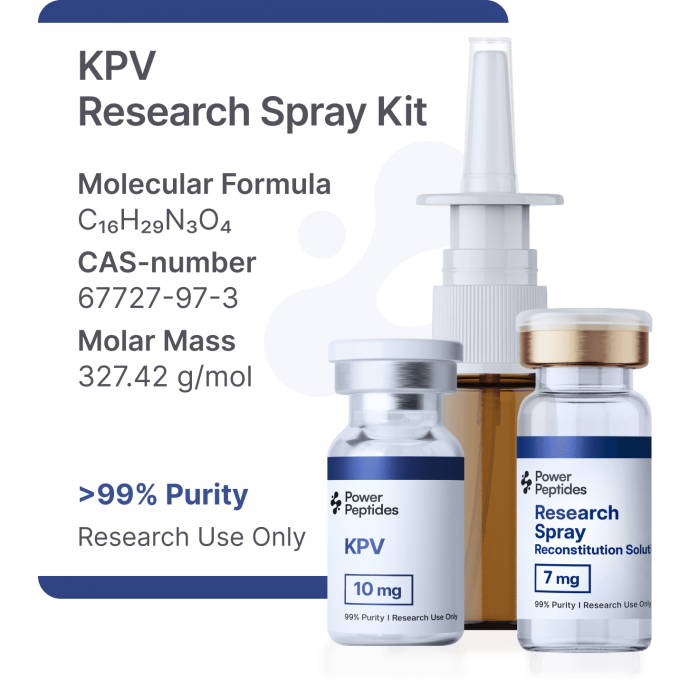
KPV Research Kit
- Ex Tax: $138.99
- Product Code: M00000006
- Availability: In Stock
CharacteristicsMolecular FormulaC16H29N3O4CAS-number67727-97-3Molar Mass327.42 g/molChemical FormulaLys-Pro-ValAmino Acid SequenceLys-Pro-ValSynonymsKPV tripeptide, α-MSH(11-13), KPV peptideSolubilityWater-soluble (≥1 mg/mL)Organoleptic ProfileWhite to off-white powderCompositionLyophilized powder -..
Available Options
Characteristics
Molecular Formula | C16H29N3O4 |
CAS-number | 67727-97-3 |
Molar Mass | 327.42 g/mol |
Chemical Formula | Lys-Pro-Val |
Amino Acid Sequence | Lys-Pro-Val |
Synonyms | KPV tripeptide, α-MSH(11-13), KPV peptide |
Solubility | Water-soluble (≥1 mg/mL) |
Organoleptic Profile | White to off-white powder |
Composition | Lyophilized powder - requires reconstitution |
How is KPV - 10mg Used in Research?
KPV is studied in laboratory research to explore the behavior and interactions of this tripeptide in controlled experimental settings. Researchers typically reconstitute the lyophilized peptide and use precision spray delivery systems to ensure consistent dosing across in vitro or in vivo studies. Laboratory investigations often examine peptide uptake, distribution, and stability, as well as interactions with cellular components under controlled conditions.
KPV is also applied in combination studies with other peptides or compounds, allowing scientists to compare experimental outcomes and evaluate potential synergistic effects. The peptide is utilized to probe molecular signaling pathways, tissue responses, and cellular behavior, providing data that supports preclinical research applications.
Summary
The KPV - 10mg Research Spray Kit contains a synthetic tripeptide supplied for controlled laboratory research. Its precision spray system enables researchers to examine peptide delivery methods, assess dose consistency, and study distribution in experimental models. In preclinical research, KPV is used to investigate cellular signaling pathways, tissue behavior, and inflammatory processes, supporting a wide range of experimental approaches in the lab.