
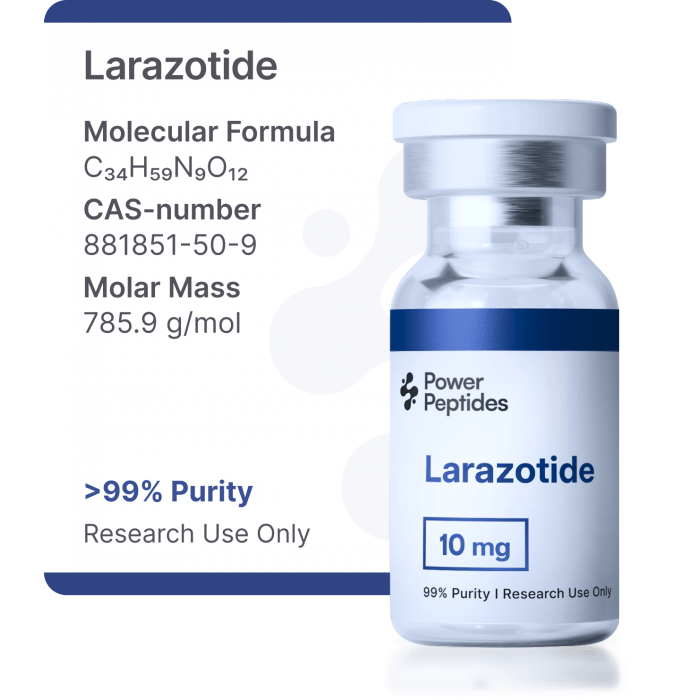
Larazotide 10mg
- Ex Tax: $121.99
- Product Code: M00000022
- Availability: In Stock
CharacteristicsMolecular FormulaC32H55N9O10CAS258818-34-7Molar Mass725.8 g/molChemical FormulaC₃₄H₅₉N₉O₁₂Amino Acid SequenceGGVLVQPGSynonyms Larazotide, Larazotide acetate, AT-1001SolubilityWater-solubleOrganoleptic ProfileWhite to off-white powderCompositionLyophilized peptide powder - requires rec..
Available Options
Characteristics
| Molecular Formula | C32H55N9O10 |
| CAS | 258818-34-7 |
| Molar Mass | 725.8 g/mol |
| Chemical Formula | C₃₄H₅₉N₉O₁₂ |
| Amino Acid Sequence | GGVLVQPG |
| Synonyms | Larazotide, Larazotide acetate, AT-1001 |
| Solubility | Water-soluble |
| Organoleptic Profile | White to off-white powder |
| Composition | Lyophilized peptide powder - requires reconstitution |
How is Larazotide Used in Research?
In laboratory settings, larazotide is incorporated into experimental workflows designed to evaluate peptide behavior in epithelial cell systems. Researchers use this peptide to support controlled studies that focus on experimental design, model comparison, and junction-related cellular processes. Common research approaches include:
- Tight junction structure studies. Examining peptide interactions with junction-associated proteins and cellular interfaces.
- Paracellular transport models. Assessing molecular movement across epithelial cell layers in controlled laboratory conditions.
- Cell signaling analysis. Studying signaling pathways associated with junction assembly, organization, and cellular model observations.
- Experimental permeability models. Using in vitro and preclinical systems to characterize epithelial model parameters under defined experimental conditions.
Summary
Larazotide 10 mg is a synthetic peptide supplied exclusively for research and laboratory use. Its defined amino acid sequence, solubility profile, and standardized lyophilized format make it suitable for controlled experimental workflows involving epithelial cell systems. Researchers utilize this peptide within in vitro and preclinical models where consistency, reproducibility, and experimental comparability are essential to peptide-cell interaction studies.