
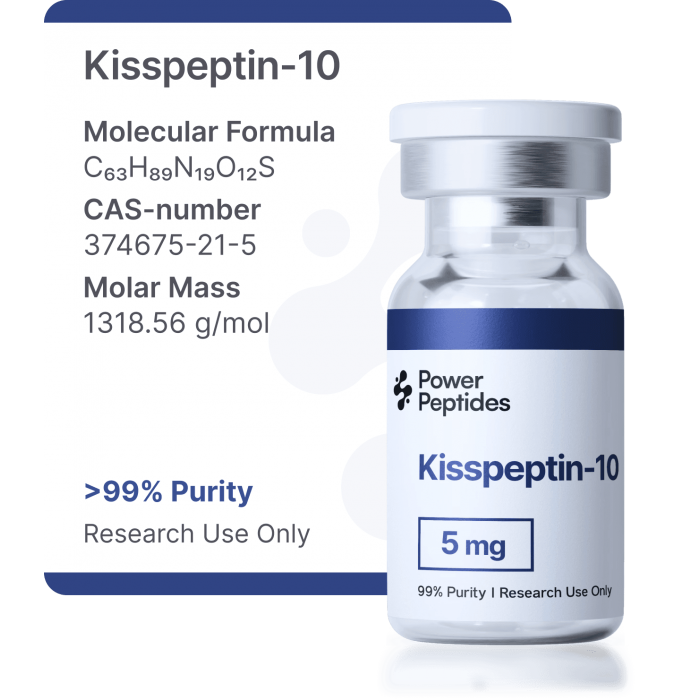
Kisspeptin-10
- Ex Tax: $64.99
- Product Code: M00000050
- Availability: In Stock
CharacteristicsMolecular FormulaC63H89N19O12SCAS-number374675-21-5Molar Mass1318.56 g/molChemical FormulaTyr-Asn-Trp-Asn-Ser-Phe-Gly-Leu-Arg-Phe-NH2Amino Acid SequenceTyr-Asn-Trp-Asn-Ser-Phe-Gly-Leu-Arg-PheSynonymsMetastin (45-54), KP-10SolubilityWater-soluble (≥1 mg/mL)Organoleptic ProfileWhite to ..
Available Options
Characteristics
Molecular Formula | C63H89N19O12S |
CAS-number | 374675-21-5 |
Molar Mass | 1318.56 g/mol |
Chemical Formula | Tyr-Asn-Trp-Asn-Ser-Phe-Gly-Leu-Arg-Phe-NH2 |
Amino Acid Sequence | Tyr-Asn-Trp-Asn-Ser-Phe-Gly-Leu-Arg-Phe |
Synonyms | Metastin (45-54), KP-10 |
Solubility | Water-soluble (≥1 mg/mL) |
Organoleptic Profile | White to off-white powder |
Composition | Lyophilized powder - requires reconstitution |
How does Kisspeptin-10 work?
Kisspeptin-10 exerts its effects primarily through binding to the G protein-coupled receptor 54 (GPR54), also known as KISS1R. This interaction triggers a signaling cascade that leads to the release of GnRH from hypothalamic neurons. The released GnRH then stimulates the anterior pituitary gland to secrete luteinizing hormone (LH) and follicle-stimulating hormone (FSH), which in turn regulate gonadal function and steroidogenesis.
Research
Physiological Roles:Puberty Onset: Research has shown that kisspeptin-10 plays a critical role in the initiation of puberty. Studies in various animal models have demonstrated that the activation of the kisspeptin system is essential for the onset of puberty and the development of secondary sexual characteristics.
Reproductive Function: Kisspeptin-10 is integral to the regulation of the reproductive axis in both males and females. It modulates the pulsatile release of GnRH, which is crucial for normal gonadal function and fertility.
Metabolic Regulation: Emerging evidence suggests that kisspeptin-10 may also be involved in metabolic regulation, potentially linking reproductive function with energy homeostasis.
Reproductive Disorders: Given its role in the HPG axis, kisspeptin-10 has been investigated as a potential treatment for various reproductive disorders, including hypogonadotropic hypogonadism and polycystic ovary syndrome (PCOS).
Infertility: Clinical trials have explored the use of kisspeptin-10 in assisted reproductive technologies, particularly for in vitro fertilization (IVF) protocols, as an alternative to traditional hormonal stimulation methods.
Hormone-Dependent Cancers: Some studies have suggested that kisspeptin-10 may have anti-metastatic properties in certain hormone-dependent cancers, such as breast and prostate cancer, although more research is needed in this area.
Summary
While kisspeptin-10 shows promise in various therapeutic applications, several challenges remain. These include optimizing delivery methods, understanding potential long-term effects, and elucidating its interactions with other neuroendocrine systems. Ongoing research aims to address these challenges and further explore the therapeutic potential of kisspeptin-10 in reproductive medicine and beyond.
In conclusion, kisspeptin-10 represents a significant area of interest in reproductive endocrinology and neuroendocrinology. Its central role in the HPG axis and potential therapeutic applications make it a valuable target for continued scientific investigation and clinical research.