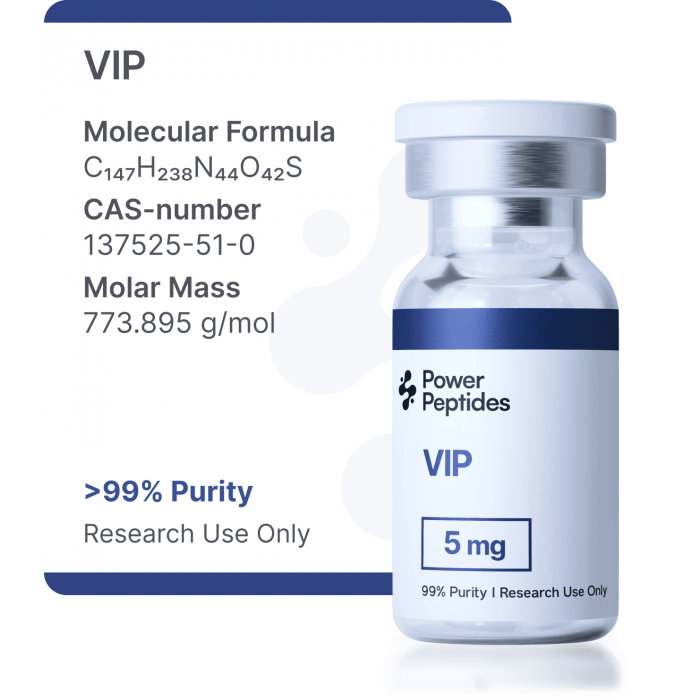
VIP
- Ex Tax: $69.99
- Product Code: M00000015
- Availability: In Stock
CharacteristicsMolecular FormulaC147H238N44O42SCAS137525-51-0Molar Mass773.895 g/molAmino Acid SequenceHis-Ser-Asp-Ala-Val-Phe-Thr-Asp-Asn-Tyr-Thr-Arg-Leu-Arg-Lys-Gln-Met-Ala-Val-Lys-Lys-Tyr-Leu-Asn-Ser-Ile-Leu-AsnSynonymsVIP, Vasoactive Intestinal Polypeptide, PHM27SolubilitySoluble in WaterOrganol..
Available Options
Characteristics
Molecular Formula | C147H238N44O42S |
CAS | 137525-51-0 |
Molar Mass | 773.895 g/mol |
Amino Acid Sequence | His-Ser-Asp-Ala-Val-Phe-Thr-Asp-Asn-Tyr-Thr-Arg-Leu-Arg-Lys-Gln-Met-Ala-Val-Lys-Lys-Tyr-Leu-Asn-Ser-Ile-Leu-Asn |
Synonyms | VIP, Vasoactive Intestinal Polypeptide, PHM27 |
Solubility | Soluble in Water |
Organoleptic Profile | White powder |
Composition | Lyophilized powder - requires reconstitution |
How is VIP studied?
Vasoactive Intestinal Peptide (VIP) is a 28-amino acid neuropeptide that has been explored in preclinical laboratory research for its interaction with G protein-coupled receptors such as VPAC1 and VPAC2. These receptors are expressed in various mammalian tissues, including the brain, intestines, and immune-related cells. In mammalian research models, VIP peptide has been observed to activate signaling pathways, including those involving cyclic AMP (cAMP), which play a role in cellular communication. These studies have explored VIP’s role in smooth muscle biology, glandular secretion, and immune cell signaling under controlled laboratory conditions. The research continues to advance understanding of complex cellular response mechanisms but does not provide conclusions regarding VIP peptide dosage, safety, or efficacy in humans.
Research Focus
Vasoactive Intestinal Peptide (VIP) has been studied in preclinical laboratory models for its role in several biological systems. In these research environments, VIP has been explored for its potential influence on:
Cell signaling pathways associated with inflammation
Neural cell communication and protection mechanisms under oxidative stress conditions
Immune response modulation, including signaling interactions involving T cell subsets
Smooth muscle behavior and vascular signaling
Respiratory and gastrointestinal cell models examining glandular and barrier function
Preclinical Observations
In preclinical laboratory studies, Vasoactive Intestinal Peptide (VIP) peptide has been investigated for its effects on biological systems such as vascular tone and gastrointestinal secretion. Some studies in mammalian models have reported changes in blood pressure, smooth muscle behavior, and glandular activity as part of the research findings. It is important to note that VIP has not been evaluated or approved for human use, and its effects in humans are not established.
Summary
Vasoactive Intestinal Peptide (VIP) is a 28-amino acid neuropeptide that has been studied in preclinical laboratory settings for its role in various biological systems. Research in mammalian models has examined VIP’s interaction with pathways involved in vascular tone, smooth muscle behavior, immune response, and cellular signaling. These investigations support its relevance in advancing understanding of neuroendocrine and immunological functions. However, VIP is not approved for human or veterinary use, and no definitive conclusions can be drawn about its safety, efficacy, or ideal VIP peptide dosage outside of experimental settings.
Resource
All products on this site are for research and development use only. Products are not for human consumption of any kind. The statements made on this website have not been evaluated by the US Food and Drug Administration....Related Products